



Learning Resources
Home/ Publications/ Learning Resources
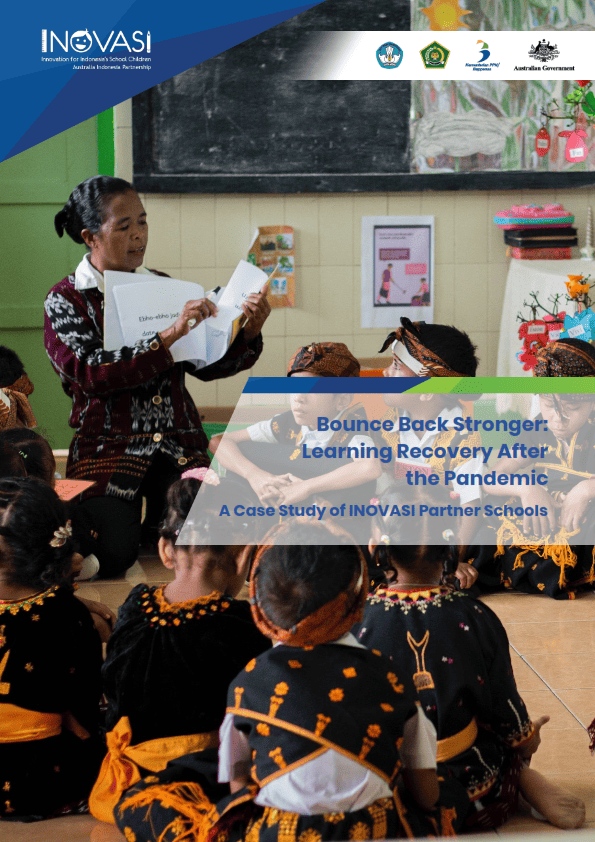
The Learning Gap Series 4 – Bounce Back Stronger: Learning Recovery After the Pandemic A Case Study of INOVASI Partner Schools
Research conducted by INOVASI at the beginning of the COVID-19 pandemic revealed that school closures significantly led to less effective learning and decreased the overall quality of education. The decline in the quality of education
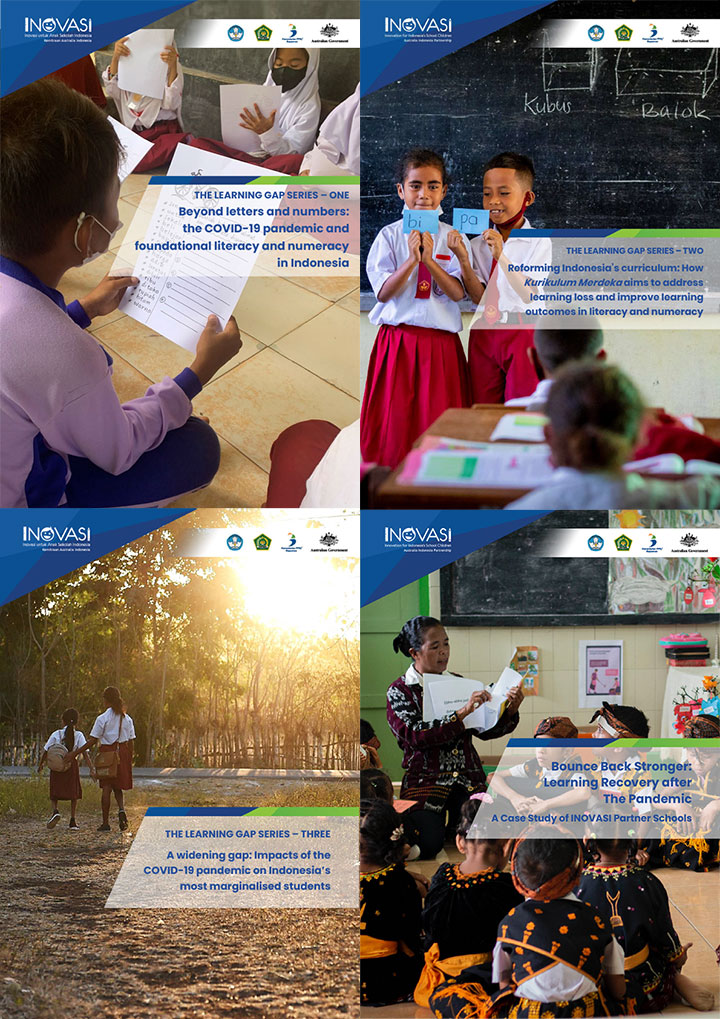
The Learning Gap Series
The Learning Gap Series 1 – Beyond Letters and Numbers: The COVID-19 Pandemic and Foundational Literacy and Numeracy in Indonesia The study aims to identify learning gaps between what the standards set for students to
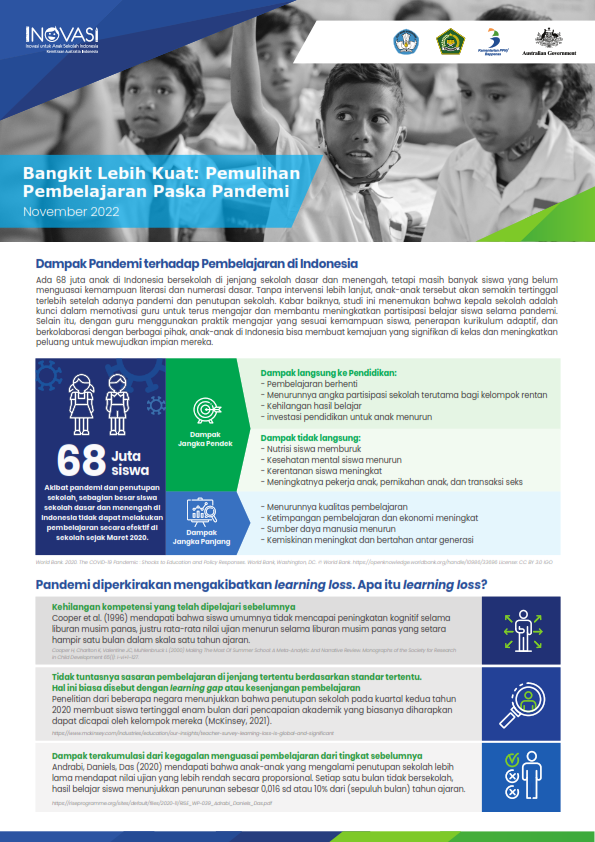
Infographic: Build Back Stronger: Post Pandemic Learning Recovery
After two years of studying during the pandemic, how are the conditions of student learning outcomes, especially in terms of literacy and numeracy? What can both government and schools do to encourage student learning recovery?
The Learning Gap Series 3 – A widening gap: Impacts of the COVID-19 pandemic on Indonesia’s most marginalised students
‘INOVASI undertook a Learning Gap Study (LGS) in 2021 to understand the status of students’ learning and the potential impact of the COVID-19 pandemic on early-grade students in Indonesia. The study intended to inform curricular,
Study of Teacher Perceptions of Gender Norms in the Management and Leadership of Female Principals: High Competence Amidst Inequality of Support
Cakra Wikara Indonesia (CWI), supported by the INOVASI program, has conducted two series of interrelated studies on the theme of female leadership as school principals. This is a second research of an initial study conducted
The Learning Gap Series 2 – Reforming Indonesia’s Curriculum: How Kurikulum Merdeka Aims to Address Learning Loss and Improve Learning Outcomes in Literacy and Numeracy
Beginning in late 2019, the Indonesian government embarked on a series of systemic education reforms, collectively referred to as Merdeka Belajar (Emancipated Learning). These reforms are set to improve learning outcomes, promote quality, and equitable education for

Policy Implementation and Sustainability: Qualitative Study of the Policies for Literacy and Multigrade Approaches in Batu City and Probolinggo with the Specific Challenge of the COVID-19 Pandemic
INOVASI has assisted 17 local governments in initiating and implementing various educational policies and programs. In this study, we focus on the following three policies: (1) Regulation by the Regent of Probolinggo No. 62 of
The Learning Gap Series 1 – Beyond Letters and Numbers: The COVID-19 Pandemic and Foundational Literacy and Numeracy in Indonesia
In 2020, with the COVID-19 pandemic spreading across Indonesia and around the world, INOVASI (the Innovation for Indonesia’s School Children) and the Indonesian Ministry of Education, Culture, Research and Technology (MoECRT) initiated a study of
Qualitative Study of Child Marriage During the COVID-19 Pandemic in East Java, West Nusa Tenggara, and East Nusa Tenggara
The government has taken important steps to reduce the number of child marriages, but the pandemic is predicted to increase the number of child marriages. Data shows that the number of child marriages and applications
Booklet: East Java Promising Teaching Practices
(Booklet only available in Bahasa Indonesia) INOVASI commenced an Education Innovations Mapping Stocktake Study in East Java in 2017, with the aim to document teaching innovations and promising practices in basic education. The study also
Making reading fun in Kaliamok Village, North Kalimantan
In September 2018, INOVASI commenced 27 grant-funded pilots, with 18 new grant partners. This grants initiative is a key part of our approach to expanding and strengthening engagement with Indonesia’s non-governmental education sector. One of
Using the Guided Reading Strategy to Improve Reading Fluency and Comprehension
Two days later, Yulius would test these students’ abilities. He found that they were able to read the given sentences fluently; however, feeling unsure of his students’ abilities, Yulius asked them to read their sentences
Nurturing Students’ Reading Enthusiasm by Reading with Expression
Mery recounted, “The room was only used to store teaching aids, mattresses, and unused school items. There were books, but they were mostly stored in cardboard boxes. The books on display were simply stacked on
Using the Local Language for Learning and Nurturing Students’ Confidence
Mariana Dembu Tamar, Principal of SD Masehi Mbatapuhu, noted, “Sometimes, the teachers would mix the use of Indonesian with the local language.” The teacher would first pronounce or read the sentence in Indonesian, followed by
Numeracy Student Worksheet (LKS): Interesting and Able to Challenge Students’ Skills
These Regional Facilitators or Fasilitator Daerah (Fasda) play an important role in the implementation of trainings aimed at improving the quality of teaching in classrooms and schools. Endang Kusniati, S.Pd., is one of the facilitators
Interested in Grade Two Student Worksheet (LKS), Even Though Still a First Grader
Based on the Minister of Education and Culture Circular Letter (SE) Number 4 of 2020, all schools in Indonesia are required to implement an educational program called Study from Home or Belajar dari Rumah (BDR).
Outside Learning Activities in Dompu Regency, West Nusa Tenggara
When learning activities could not run as usual, the principal and teachers tried their hardest to find ways for their students to be able to continue to learn. This is what happened to Haryono, S.Pd.,
The Implementation of Contextual Learning Model during the Pandemic
Clearly, the curriculum targets cannot be met. With these limited conditions, teachers are starting to be selective in choosing what they are going to teach their students. At SDN 1 Jenggala state elementary school in
The NTB Reading Consortium Hosts a Webinar Discussion, “Literacy in the Era of Disruption”
On 6 June 2020, the NTB Reading Consortium held a webinar discussion on literacy entitled, “Literacy in the Era of Disruption.” This online discussion presented several literacy activists as the main speakers. These activists have