



National Education Day serves as a reminder that every child has the right to quality education. This commitment is reflected in various school efforts to ensure that no child is left behind.
One such example comes from SD Katolik Doki in Ua Village, Mauponggo Subdistrict, Nagekeo Regency, East Nusa Tenggara.
Four years ago, the school stood at a difficult crossroads. Students’ literacy levels were very low, and the school’s remote location placed it far from access to essential education services. Yet within just three years, the school began to draw attention for its significant improvement in students’ literacy.
The journey to SD Katolik Doki—marked by steep, rocky, and uneven road, reflects the daily challenges faced by the school community. Many students come from farming families, where much of their time is spent helping their parents, leaving limited time for learning at home.
When the school’s literacy outcomes were found to be below minimum competency levels, Principal Maria Sefriana Sebo saw this as a starting point for change. “I saw it as my responsibility as a principal,” she said.
Through reading ability assessments and instruction tailored to students’ learning levels, supported by the Nagekeo District Government and INOVASI, the Australia–Indonesia Partnership, SD Katolik Doki has demonstrated that improving literacy begins with understanding each child’s needs.
Starting with Data: Understanding Every Student
The process began with teachers conducting regular reading assessments to understand each student’s needs. The results were used to map students’ abilities, ranging from letter recognition, syllable reading, to reading comprehension. “Teachers must know each child’s reading level,” Maria explained . This approach aligns with the principle of Teaching at the Right Level.
Maria also established a support team to strengthen student learning more intensively. Students who had not yet mastered letter recognition were supported through creative and engaging learning methods.
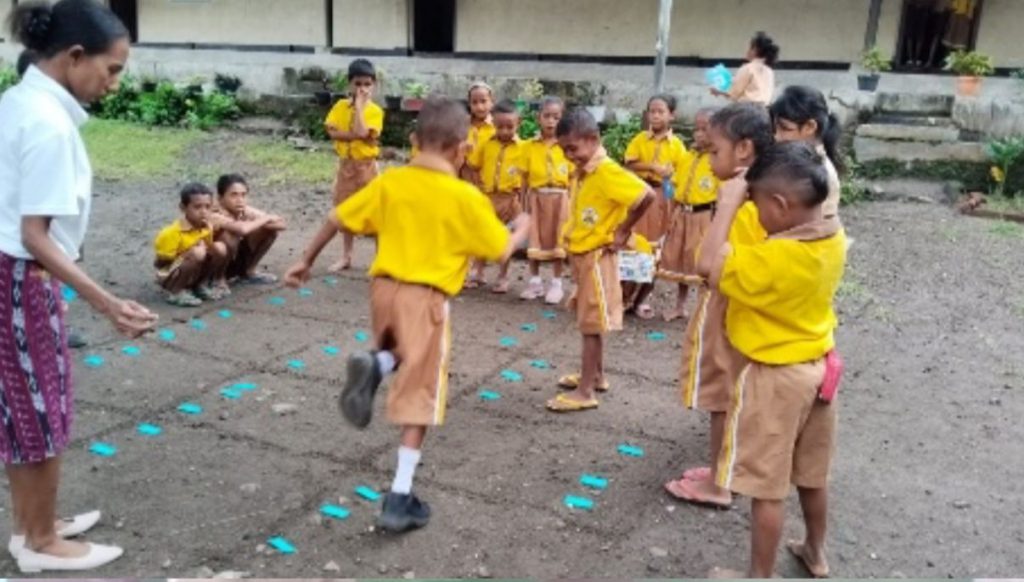
In the classroom, students learned to recognise letters using simple flashcards, then practise reading syllables through activities such as clapping syllables. Outside the classroom, traditional games like “ogo” were used as contextual learning tools for reading. The school has also began using digital tools, such as interactive boards, to present illustrated stories and learning videos.
Building Reading Habits: Consistency that Drives Change
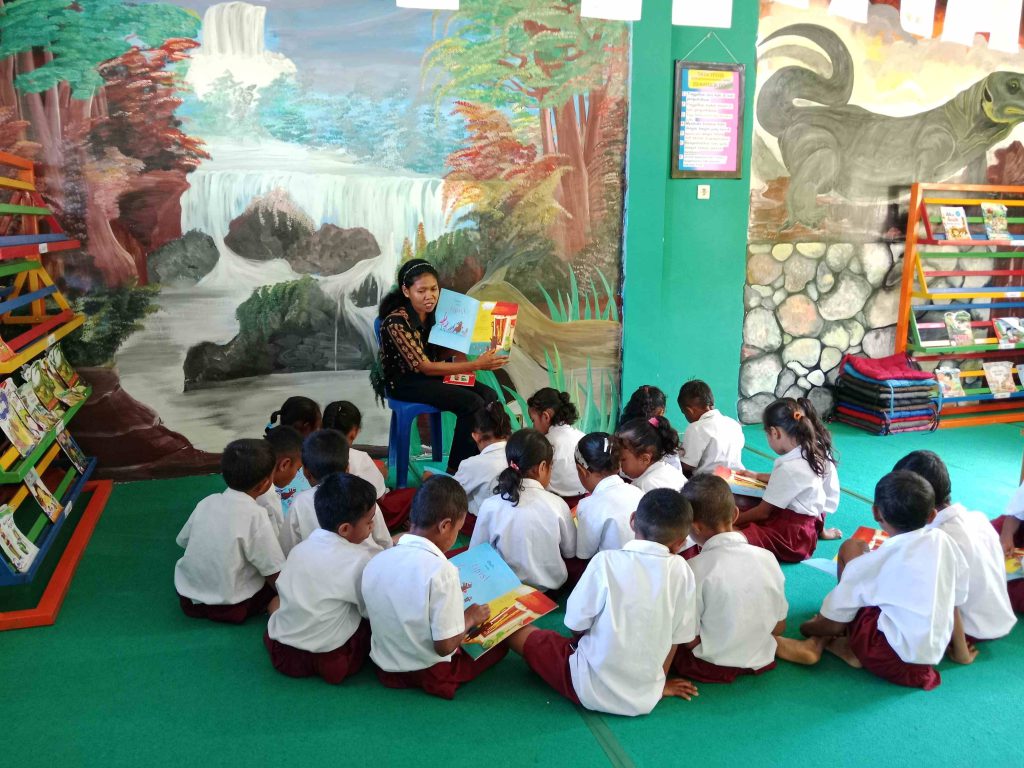
Change did not stop at teaching methods; it extended to building habits. The school introduced daily reading routines before lessons begin. The duration increased from 15 minutes to 35 minutes, and up to one hour, with guidance tailored to students’ reading levels. Students are not only asked to read but also to retell what they have read.
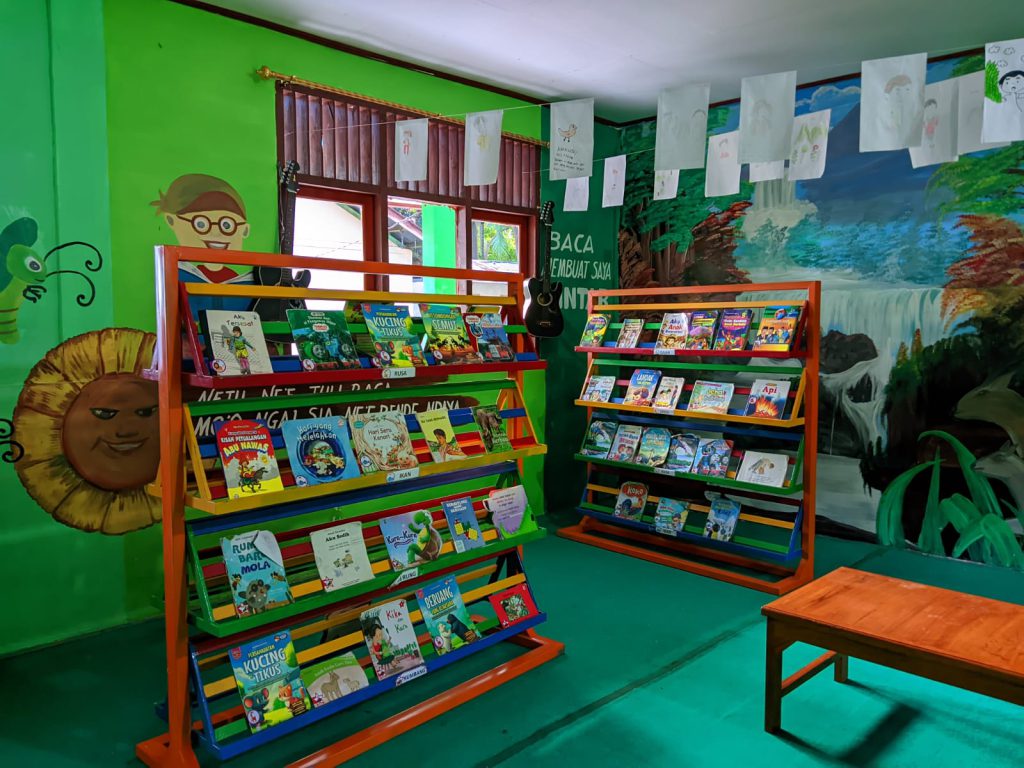
At the same time, the school developed a child-friendly library with levelled reading materials suited to students’ abilities.
Tangible Impact: From Individual Progress to School Outcomes
Consistent efforts have begun to show results, both at the individual student level and across the school. “One of our students was still reading at the syllable level in Grade 4. That was a challenge for us. However, with consistent support from teachers, the student is now able to read with comprehension,” Maria shared.
Not only did his reading ability improve, but the student’s interest in reading has also increased.
This individual progress is reflected in the school’s overall performance. Literacy achievement has shown a significant increase—from below minimum competency in 2021 to a good category in 2025 based on the Education Report Card.
This data shows that consistent efforts not only impact individual students but also contribute to broader improvements in teaching and learning quality at the school level. National Education Day becomes an important moment to reaffirm this commitment—that every child, wherever they are, has the right to learn, grow, and achieve their aspirations.