


Where We Work
Home/Where We Work
Nasional
At the national level, INOVASI provides support to the Ministry of Education, Culture, Research, and Technology (Kemendikbudristek) and the Ministry of Religious Affairs (Kemenag) with various focuses. These include responses and recovery efforts from the impact of COVID-19, gender, disability, and social inclusion (GEDSI), the new national curriculum, assessment systems, recruitment standards, training, assignments, and teacher professional development, as well as new approaches to character education and religious moderation. Together with Kemendikbudristek, Kemenag, and Bappenas, INOVASI continues to strengthen collaboration at the central and regional levels—particularly in the four program partner provinces—to strengthen strategic two-way planning.
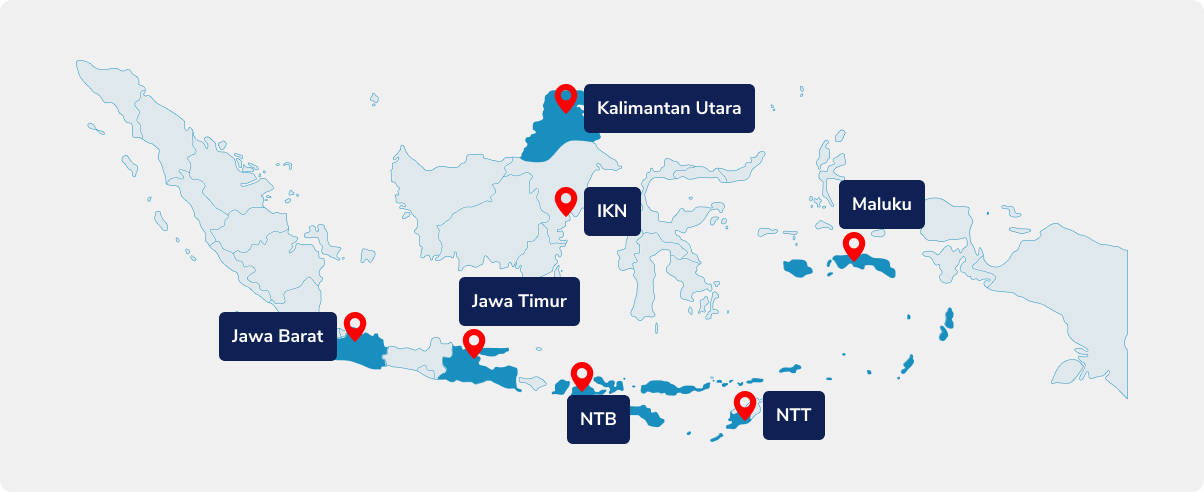
Innovation for Indonesian School Children (INOVASI) is a collaborative program between the Australian and Indonesian governments. INOVASI works with the Ministry of Education and Culture (Kemendikbud), the Ministry of Religious Affairs (Kemenag), the Ministry of National Development Planning/National Development Planning Agency (Bappenas), and regional partners in the provinces of West Nusa Tenggara, East Nusa Tenggara, North Kalimantan, and East Java. The program seeks to identify and support changes in learning practices, systems, and education policies that can significantly accelerate improvements in student learning outcomes. INOVASI is managed by Palladium on behalf of the Australian Government, through the Australian Department of Foreign Affairs and Trade (DFAT), and officially commenced on January 18, 2016.
This eight-year program (2016-2023) supports government partners (at the national and regional levels) in identifying and understanding systemic issues impacting teaching and learning outcomes in Indonesia, and in developing and implementing local solutions. The program focuses on three areas for identifying and supporting change: the quality of classroom teaching, the quality of support for teachers, and learning for all children. Good student learning outcomes in basic education will provide the foundation for a more skilled Indonesian workforce that will be a driver of the economy and stability.
Related News
Find out what’s going on and stay up to date.