


The Role of Mother Tongue in Early Grade Literacy
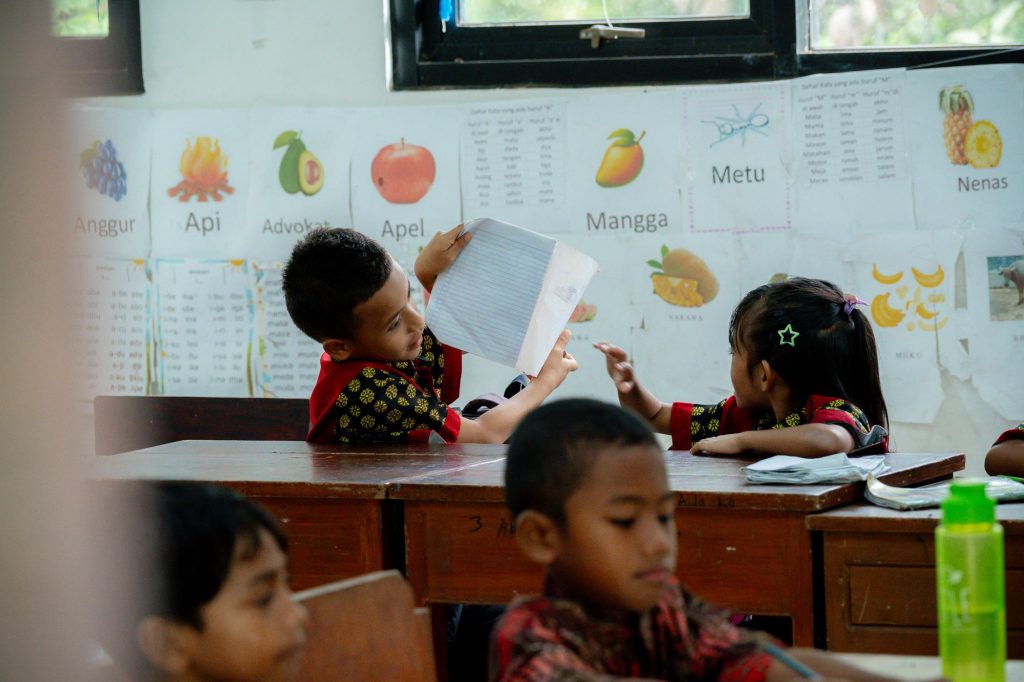
Indonesia is home to 729 local languages spoken in daily community life. For most children, their mother tongue is the first language they hear and use to make sense of the world—naming objects, expressing needs, and interacting with family.
Yet when children enter early primary school, they are expected to learn in Bahasa Indonesia from the very beginning. This sudden shift can make learning to read and write particularly challenging in the early grades.
Mother tongue–based learning helps bridge this gap. It enables children to build foundational literacy skills in a language they already understand, before gradually transitioning to Bahasa Indonesia. This approach has been developed through the partnership between the Australia-Indonesia Governments under the INOVASI program, and is implemented with local governments in several regions, including Nagekeo District in East Nusa Tenggara.
Changes in Classroom Practice in the Early Grades
At SDI Wudu and SDN Aebowo, teachers once faced a familiar challenge: early grade students who hesitated to read or respond to questions. Children looked at the text but did not always grasp its meaning. Teachers often repeated explanations several times, without certainty that all students truly understood.
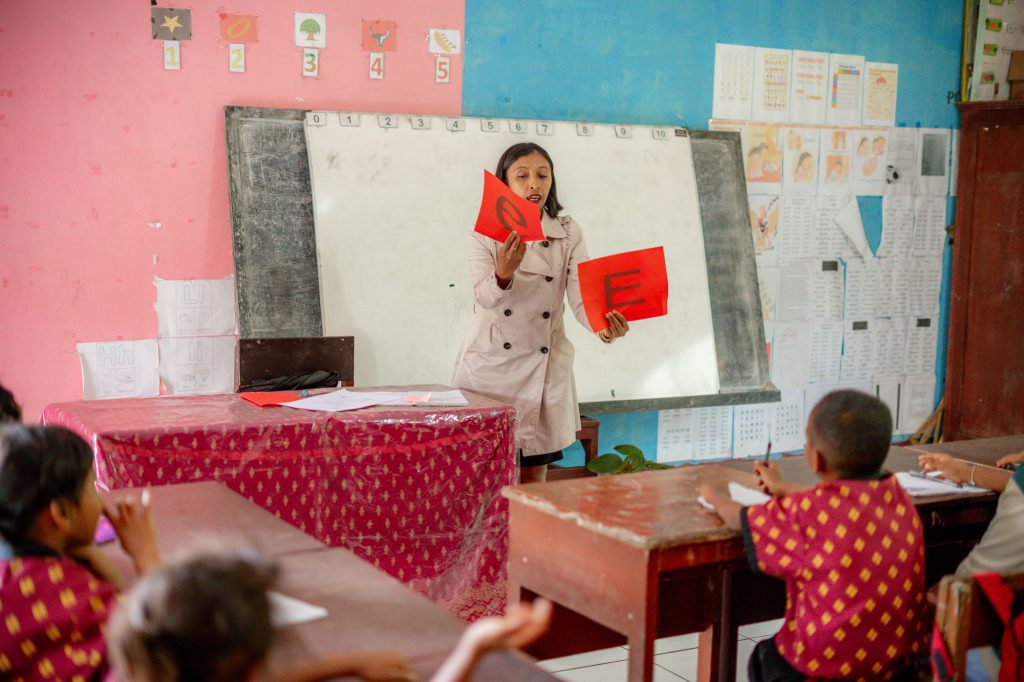
Change began when teachers started using the mother tongue in daily classroom interactions. Simple explanations, storytelling, and discussions were first delivered in a language familiar to the children, before gradually linking them to Bahasa Indonesia. With a language they understood, children grasped meaning more quickly, became more willing to speak, and were less afraid to try reading.
The principal of SDI Wudu, Ms Merry, observed a clear shift in classroom dynamics after the approach was introduced.
“Children learn quickly, and teachers feel that using the mother tongue is very helpful,” she said.
Teachers Also Learning New Ways to Teach
For teachers, using the mother tongue was not simply a change in instructional language. They adapted how they explained concepts, selected appropriate vocabulary, and connected the mother tongue with Bahasa Indonesia step by step so children could understand both.
The principal of SDN Aebowo, Ms Bergita, described the experience as a shared learning journey. “Not only are the children learning, but teachers are learning too,” she said.
Practice in both schools has been further strengthened through integration with the Student Learning Profile (Profil Belajar Siswa/PBS), a tool used to identify early learning difficulties in the early grades. With clearer mapping of learning needs, teachers can design support that matches each child’s development.
Teachers also participate in cross-learning and teacher-exchange activities, visiting each other’s classrooms and sharing experiences in using the mother tongue for literacy. These exchanges have strengthened teachers’ confidence in continuing to apply contextual approaches.
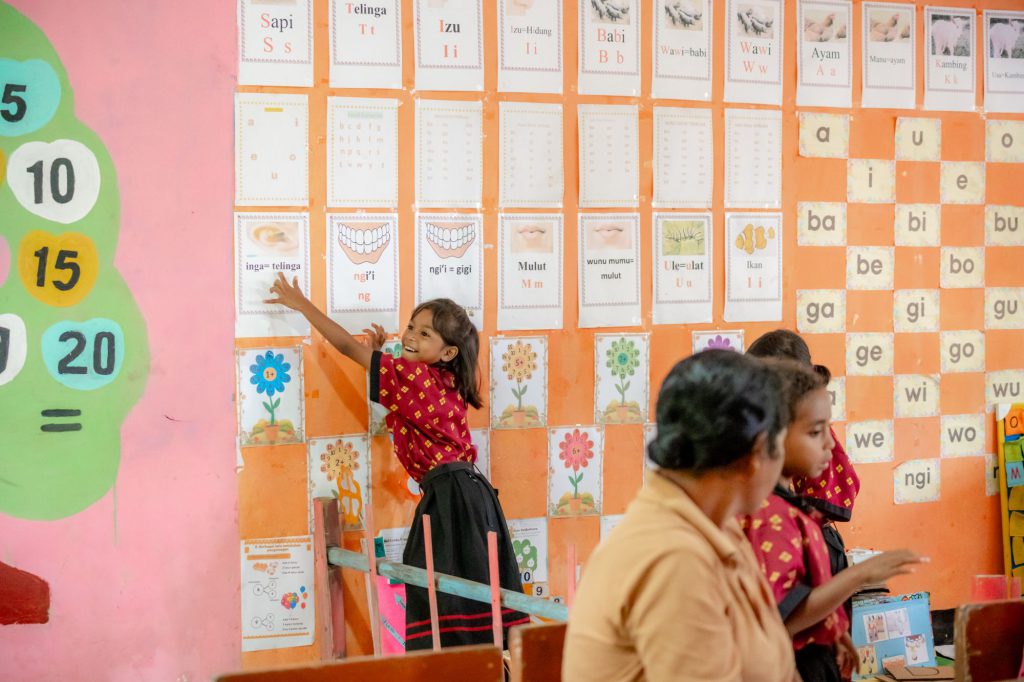
(© Photo by INOVASI Communication Team)
A Language that Opens Children’s Path to Literacy
Over time, changes in students have become increasingly visible. Children are more confident in answering questions, actively telling stories, and willing to read aloud.
Since 2021, the Nagekeo District Government and INOVASI have been developing mother tongue–based early literacy learning in early childhood centres and early grades. The approach has now reached five sub-districts, 39 primary schools, and 39 preschools and kindergartens, benefiting more than 2,000 young learners.
Experiences from SDI Wudu and SDN Aebowo show that the mother tongue is not merely a marker of cultural identity, it is a foundational pathway that helps every child begin their reading journey with confidence.