



Learning Resources
Home/ Publications/ Learning Resources
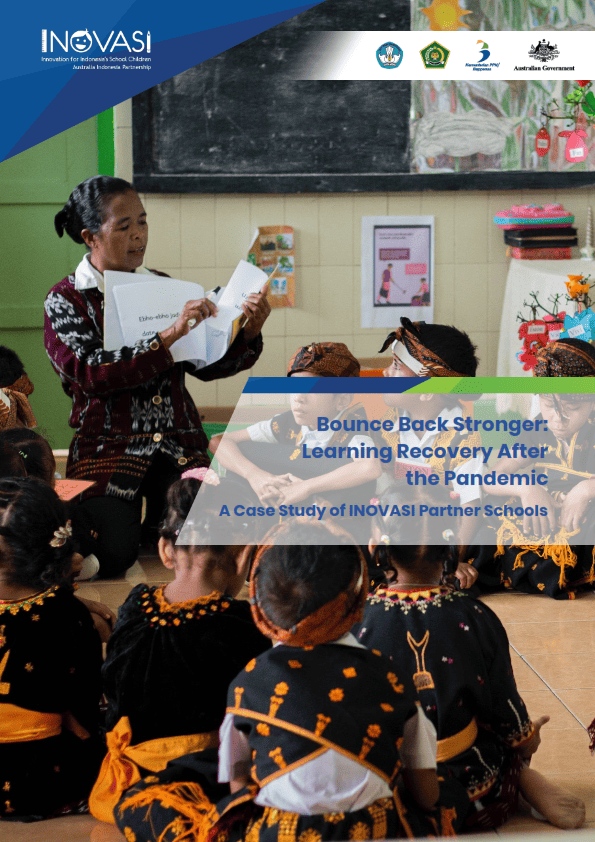
The Learning Gap Series 4 – Bounce Back Stronger: Learning Recovery After the Pandemic A Case Study of INOVASI Partner Schools
Research conducted by INOVASI at the beginning of the COVID-19 pandemic revealed that school closures significantly led to less effective learning and decreased the overall quality of education. The decline in the quality of education
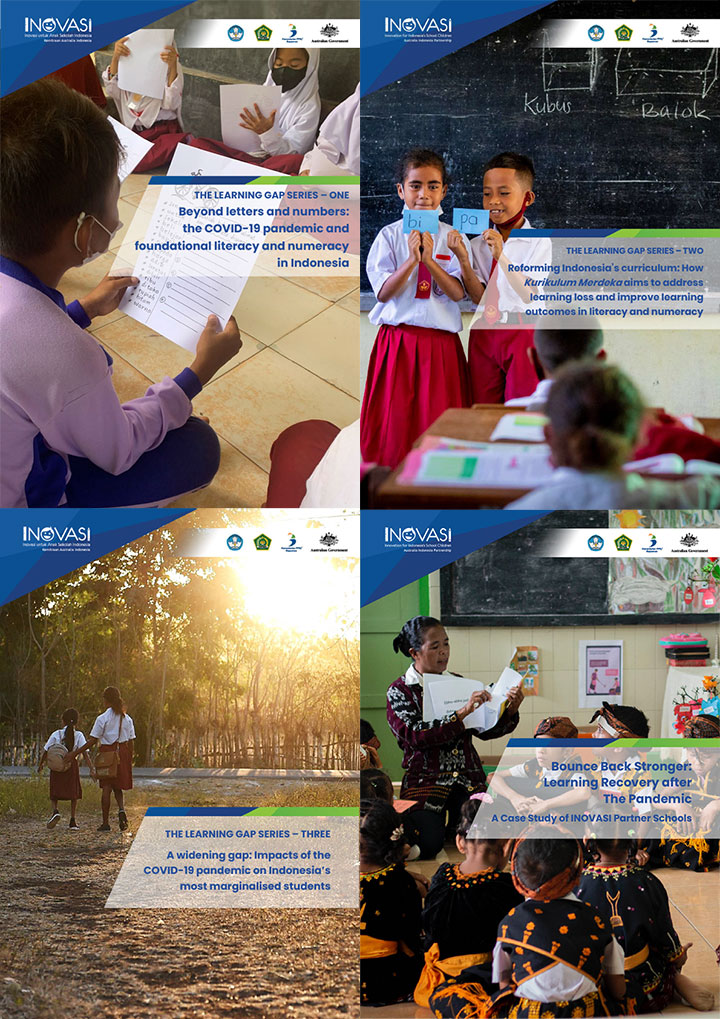
The Learning Gap Series
The Learning Gap Series 1 – Beyond Letters and Numbers: The COVID-19 Pandemic and Foundational Literacy and Numeracy in Indonesia The study aims to identify learning gaps between what the standards set for students to
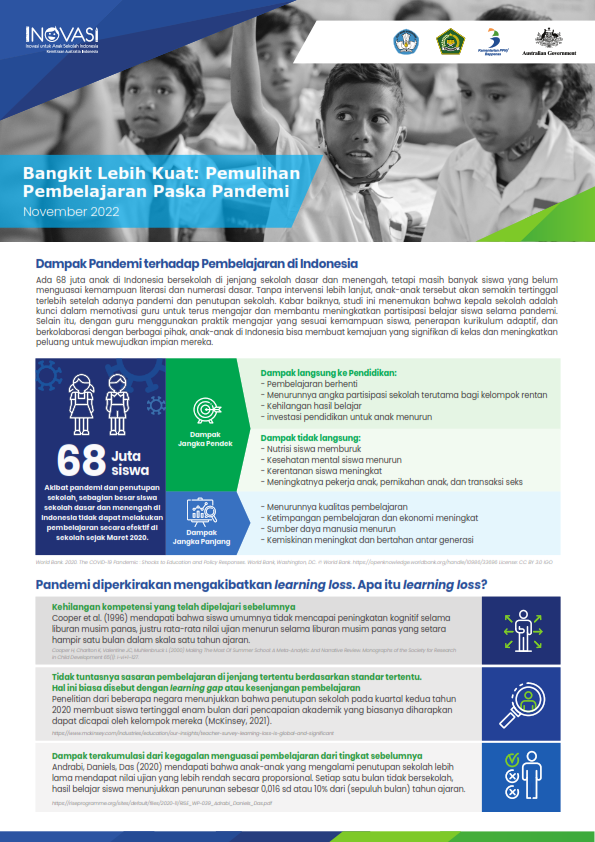
Infographic: Build Back Stronger: Post Pandemic Learning Recovery
After two years of studying during the pandemic, how are the conditions of student learning outcomes, especially in terms of literacy and numeracy? What can both government and schools do to encourage student learning recovery?
The Learning Gap Series 3 – A widening gap: Impacts of the COVID-19 pandemic on Indonesia’s most marginalised students
‘INOVASI undertook a Learning Gap Study (LGS) in 2021 to understand the status of students’ learning and the potential impact of the COVID-19 pandemic on early-grade students in Indonesia. The study intended to inform curricular,
Study of Teacher Perceptions of Gender Norms in the Management and Leadership of Female Principals: High Competence Amidst Inequality of Support
Cakra Wikara Indonesia (CWI), supported by the INOVASI program, has conducted two series of interrelated studies on the theme of female leadership as school principals. This is a second research of an initial study conducted
The Learning Gap Series 2 – Reforming Indonesia’s Curriculum: How Kurikulum Merdeka Aims to Address Learning Loss and Improve Learning Outcomes in Literacy and Numeracy
Beginning in late 2019, the Indonesian government embarked on a series of systemic education reforms, collectively referred to as Merdeka Belajar (Emancipated Learning). These reforms are set to improve learning outcomes, promote quality, and equitable education for

Policy Implementation and Sustainability: Qualitative Study of the Policies for Literacy and Multigrade Approaches in Batu City and Probolinggo with the Specific Challenge of the COVID-19 Pandemic
INOVASI has assisted 17 local governments in initiating and implementing various educational policies and programs. In this study, we focus on the following three policies: (1) Regulation by the Regent of Probolinggo No. 62 of
The Learning Gap Series 1 – Beyond Letters and Numbers: The COVID-19 Pandemic and Foundational Literacy and Numeracy in Indonesia
In 2020, with the COVID-19 pandemic spreading across Indonesia and around the world, INOVASI (the Innovation for Indonesia’s School Children) and the Indonesian Ministry of Education, Culture, Research and Technology (MoECRT) initiated a study of
Qualitative Study of Child Marriage During the COVID-19 Pandemic in East Java, West Nusa Tenggara, and East Nusa Tenggara
The government has taken important steps to reduce the number of child marriages, but the pandemic is predicted to increase the number of child marriages. Data shows that the number of child marriages and applications
Mother Tongue-Based Multilingual Education to Prepare the 21st-Century Generation
Education is key in preparing a generation that can meet the life challenges of the 21st century. In response to this, the Government of Indonesia has integrated the 4C’s as the final learning goal of
Learning while Playing with ‘Ultrasi’ (Si Ular Tangga Numerasi/Numeracy Snakes and Ladders)
It’s really fun to play snakes and ladders, especially when the children are learning math at the same time. Dalilatus Sholihah, S.Pd., a teacher at Islamic elementary school MI Darussalam in Candi district, Sidoarjo regency,
From Learning “As Is” to Learning “Wow! What’s that?”
The reason for this is not because these schools don’t want to apply this learning concept—it’s because school resources, in this case the teachers and supporting facilities, especially learning media, have felt inadequate to meet
Utilizing Unused Objects to Make a Literate Classroom
Yandri’s initiative to collect unused items came to be after seeing the condition of empty classrooms. This condition has remained the same since the school asked him to teach as a grade 2 teacher in
Playing Smart Dice Game to Help Improve Student’s Literacy
In order for students to learn everything about animals, how they reproduce, and how they live, while teaching about literacy at the same time, I have created a simple game called Datar or Dadu Pintar
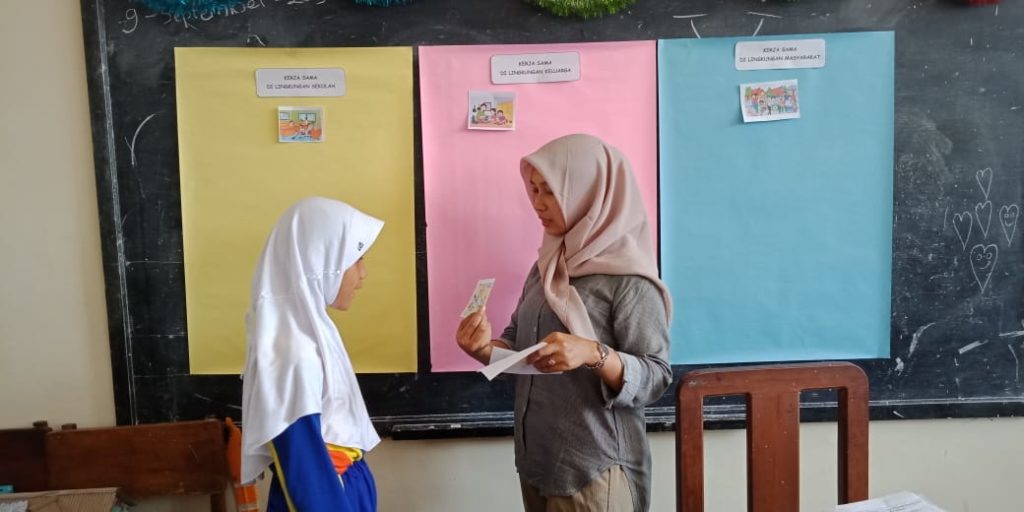
Social Activity Pictures Used as a Literacy Medium for Special Needs Students
Being a teacher is a profession that most students aspire to when asked what they want to do when they grow up. This, of course, is something Mismiati, S.Pd., a grade 3 teacher at SDN
Guided Reading Activity to Improve Students’ Reading Fluency and Understanding
Students in grade three of elementary school are expected to be able to read fluently. In reality, there are still students who don’t know all the letters of the alphabet or who read by spelling
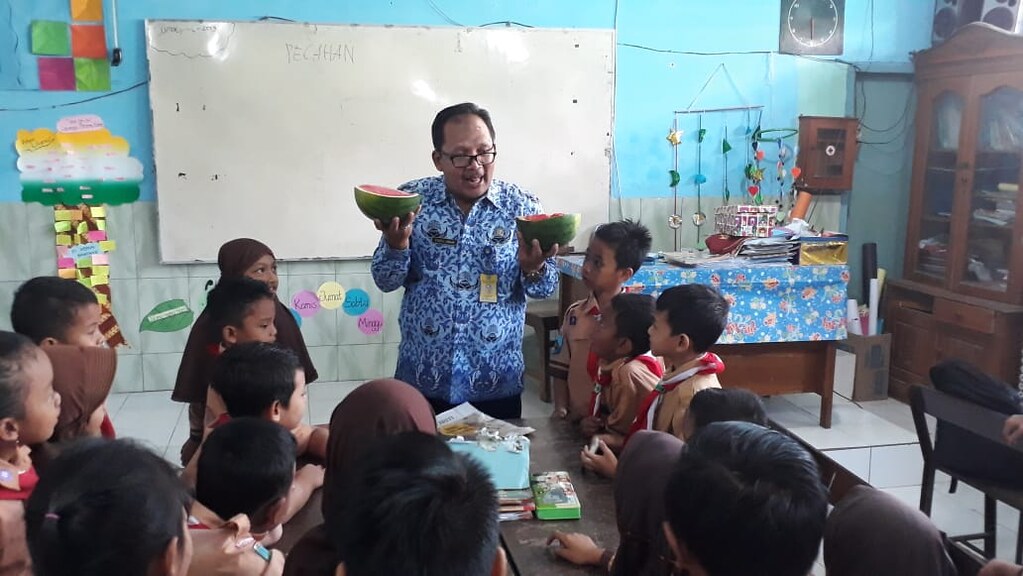
Using a Watermelon to Teach Fractions
By Fikrul Umam, S.Pd., a teacher at SDN Kludan state elementary school in Tanggulangin subdistrict, Sidoarjo regency, East Java It’s not easy for students to understand the counting operations of fractions. Students who are directly
Local solutions to improve education quality explored at Temu INOVASI forum in Jakarta
Hosted in the Ministry of Education and Culture’s Graha Meeting Room, the event was attended by more than 200 provincial and national stakeholders from Indonesia’s education sector. This included teachers, principals, supervisors, government officials, and
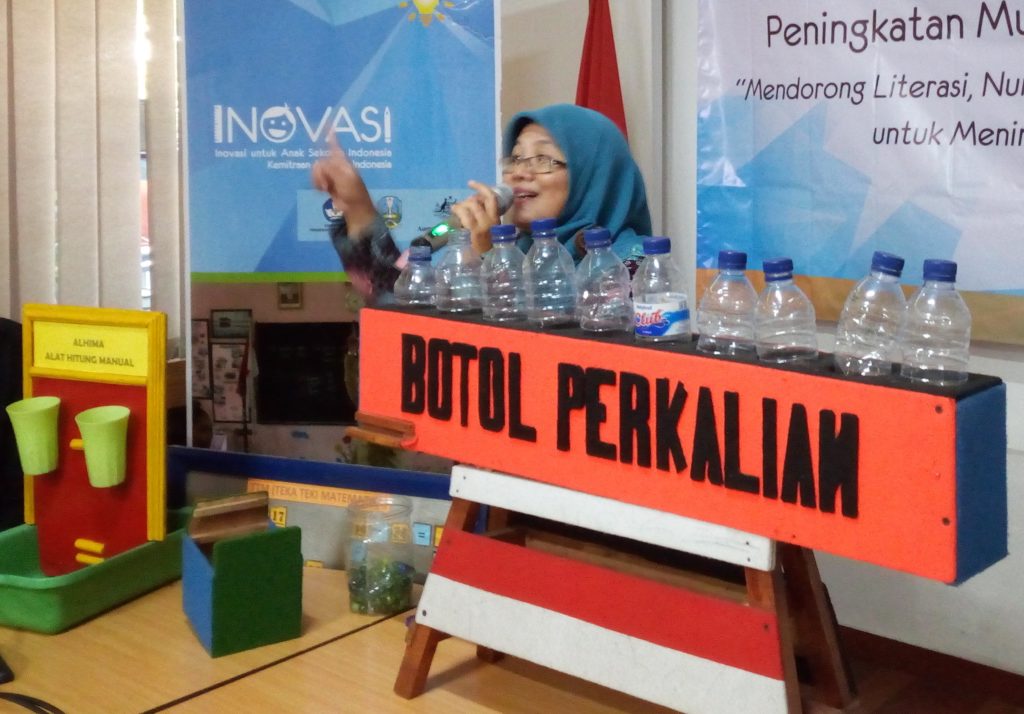
Endang Kusniati, Turns Mathematics into Something Fun
She made learning tools to help grade 1 and 2 students understand the concepts of mathematics easily. According to her, if students already understand the concept, they will easily do math problems. “Understanding this concept
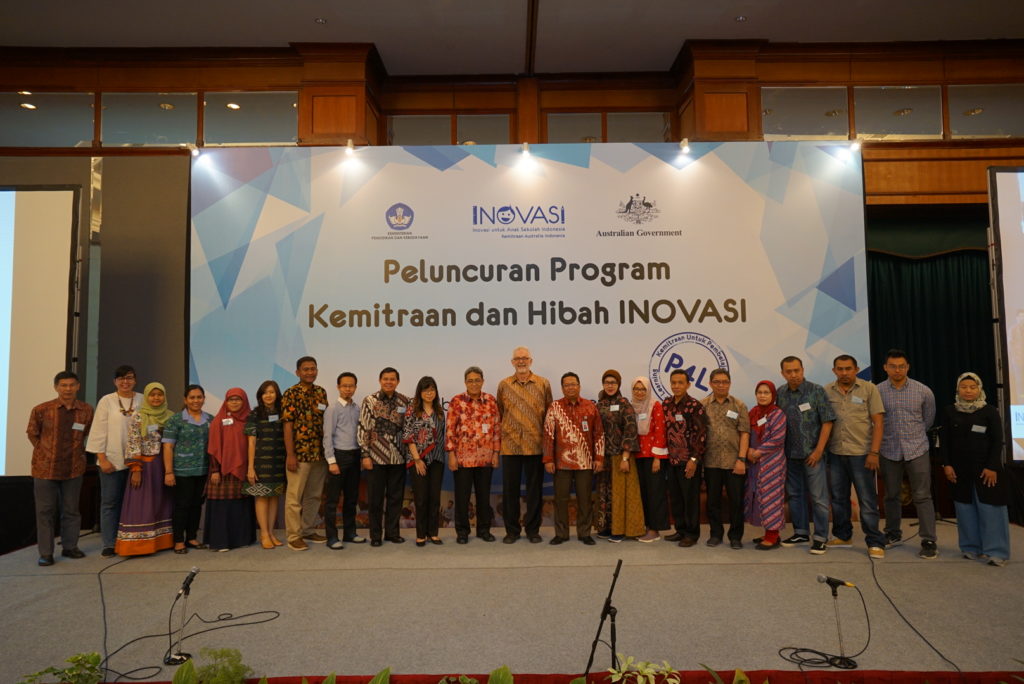
INOVASI launches new partnership agreements with education organisations in Indonesia
This includes with CIS Timor, Dompet Dhuafa, Edukasi 101, Forum Lingkar Pena, Sahabat Pulau Indonesia, Jaringan Semua Murid Semua Guru, SIL, Taman Bacaan Pelangi, Universitas Bina Nusantara (BINUS), Universitas Borneo Tarakan (UBT), Universitas Islam Negeri

In Indonesia, innovative education programs highlight teachers’ education gap
Supporting children in remote areas of the country, and those speaking a language at home different to that of the national curriculum, requires new ideas and approaches to build capacity. Australian Aid’s Innovation for Indonesia’s

Story of Warsiah, the Principal Who Build Bridges so Teachers and Students Can Go to School
The principal of SD 013 Buluh Perindu, Warsiah, said that the school is separated by a river as wide as 100 meters from the residential area. This was an obstacle for students and teachers to
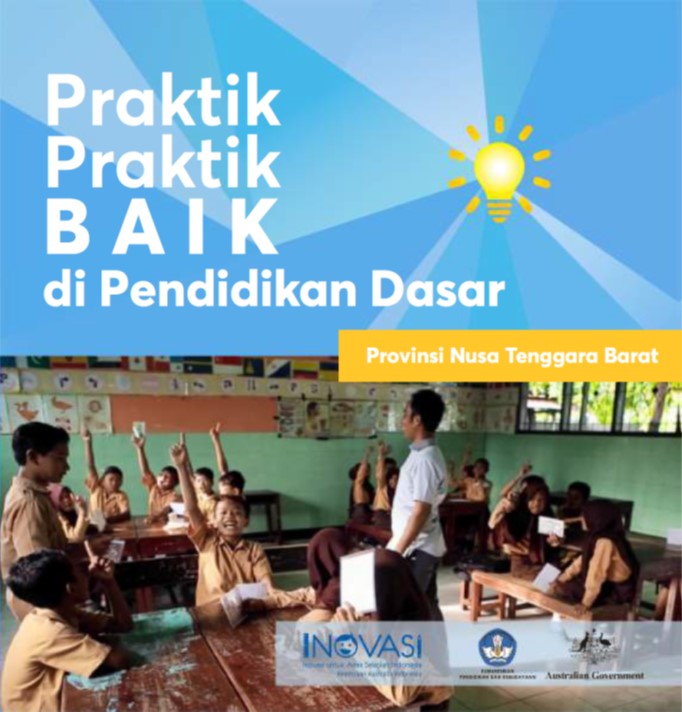
Promising Practices in Primary School (NTB)
(Booklet only available in Bahasa Indonesia) This booklet contains of promising practices in primary schools in Nusa Tenggara Barat.
Exploring literacy problems and learning solutions in North Kalimantan
In North Kalimantan and in all partner districts and provinces, INOVASI uses a distinctive approach to develop pilot activities and find out what does and doesn’t work to improve student learning outcomes. In simple terms,
Local Facilitators learn a new way of problem solving in North Kalimantan
INOVASI activities in North Kalimantan are focused on literacy in the early grades. Results from Indonesia’s National Assessment Programme (INAP) show that the average literacy score for North Kalimantan is two points lower than the